Body Fat Estimate Pictures: How to Visually Estimate Body Fat Percentage from Photos
A practical photo-based guide to reading visual body fat signs, avoiding common picture mistakes, and using AI estimates without confusing them with medical measurements.
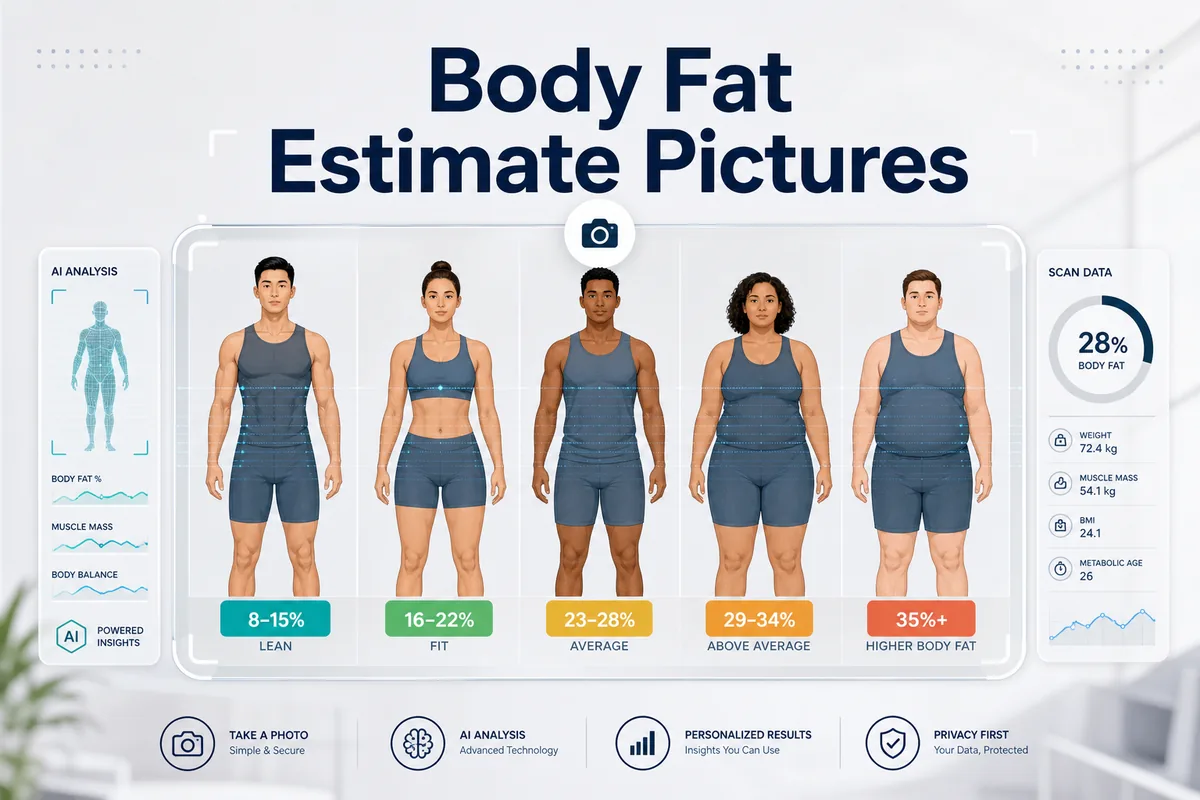
Table of Contents
Can You Estimate Body Fat Percentage from Pictures?
Yes, a body fat percentage by picture can be useful when you need a quick, visual range. Fitness coaches often make rough visual estimates by looking at abdominal definition, shoulder and arm separation, waist shape, lower-back fat, hip and thigh distribution, and how much muscle contour is visible. A photo can show these signals better than scale weight alone.
The important limit is that pictures do not measure tissue. A person can look leaner or softer depending on lighting, hydration, pose, pump, clothing, camera angle, and where they store fat genetically. That is why body fat estimate pictures should usually be read as ranges, such as 15-18% or 25-30%, instead of exact numbers like 16.4%.
For most users, the practical goal is not laboratory precision. The goal is to answer: am I trending leaner, maintaining, or gaining visible body fat? If you want a fast second opinion, use the AI Body Fat Calculator after reading this guide. If you want a height-and-weight screen, compare it with the BMI Calculator.
Best use case
Use visual body fat percentage estimates to track changes over weeks or months. Avoid using one casual mirror selfie as a final body composition result.
What Makes a Good Body Fat Photo?
The quality of the body fat photo matters as much as the estimator. If the image hides the torso, distorts proportions, or uses dramatic shadows, both humans and AI tools will have less reliable visual information.
Use consistent photo conditions
- Use front-facing posture: stand relaxed, not flexed, with arms slightly away from the torso.
- Use even lighting: daylight or soft indoor lighting works better than harsh overhead shadows.
- Keep the camera level: chest-height framing reduces distortion compared with low-angle or high-angle shots.
- Wear fitted clothing: fitted activewear, swimwear, or similar clothing reveals body shape without requiring nudity.
- Repeat the setup: same room, same distance, same time of day, and same pose make progress comparisons more useful.
If your goal is to visually estimate body fat percentage over time, consistency beats perfection. A slightly ordinary photo taken the same way every month is more useful than a highly polished photo taken once.
A quick quality gate for body fat estimate pictures
Before trusting a body fat by picture estimate, check whether the image is good enough for a human coach or AI tool to read consistently.
- Pass: Front-facing, level camera, visible torso, fitted clothing, and even light.
- Retake: Mirror angle, cropped waist, baggy clothing, harsh shadows, or flexed pose.
- Compare later: Use the same setup every 2-4 weeks, then compare ranges rather than exact decimals.
Visual Body Fat Percentage Guide for Men and Women
Body fat ranges look different by sex, muscle mass, age, and fat distribution. The table below is a practical photo-reading guide, not a clinical definition. It combines common fitness-category language with visible signs people usually look for in body fat by picture comparisons.
| Estimated range | Men: common visual signs | Women: common visual signs | How to read the picture |
|---|---|---|---|
| Athletic / very lean | Visible abs, clear shoulder and arm separation, low waist softness. | Clear muscle tone, lean waist, visible definition in arms or legs. | Look for definition that remains visible without extreme flexing. |
| Fitness / lean | Some abdominal outline, visible chest and arm shape, moderate waist definition. | Toned waist and legs, softer but still defined shape, some muscle contour. | Use relaxed photos, because flexing can make this range appear leaner. |
| Average / healthy range | Less abdominal definition, softer waist, muscle shape still partly visible. | Softer midsection and hips, natural curves, limited muscle separation. | Compare waist, side profile, and limb definition instead of only abs. |
| Above average body fat | Noticeable waist and lower-back fat, little muscle separation. | More visible fat storage around waist, hips, thighs, or arms. | Loose clothing can hide the actual range, so photo setup matters more. |
| High body fat | Rounder waist, limited torso definition, higher abdominal fat storage. | Higher visible fat storage across waist, hips, thighs, back, or arms. | Use estimates as a screening signal and consider medical context when needed. |
For a quick reference table of ranges, see the body fat percentage chart on the calculator page. Remember that two people at the same percentage can look different if one has more muscle mass or stores fat in different places.
Common Mistakes When Comparing Body Fat Pictures
Many inaccurate visual body fat percentage estimates come from comparing photos that were never comparable. A gym pump, deep shadows, angled mirror, or flexed pose can make the same person appear several percentage points leaner.
Mistake 1: using abs as the only signal
Visible abs are useful, but they are not the whole story. Some people show abdominal outlines at higher body fat because of muscle shape, while others store fat around the midsection and hide abs even when they are relatively lean. Look at the full torso, waist, back, arms, and legs.
Mistake 2: comparing men and women with the same visual threshold
Healthy body fat ranges differ by sex. Women usually carry more essential fat, so a woman and a man with the same visual leanness category will often have different body fat percentages. A reliable guide should not apply male visual standards directly to female photos.
Mistake 3: ignoring muscle mass
Muscle changes the visual result. A muscular person can look leaner at the same body fat percentage because muscle creates more visible shape and separation. A less muscular person may look softer at the same percentage.
Mistake 4: treating one photo as a measurement
A single picture can be a useful clue, but a sequence is better. If your waist shape, side profile, and muscle definition change across consistent monthly photos, that trend is more meaningful than one exact estimate.
Photo Estimate vs BMI, Navy Method, and DEXA
Each method answers a different question. A picture body fat percentage estimate shows visual body composition. BMI screens height and weight. Tape methods estimate body fat from body circumferences. DEXA can measure body composition more directly, but it is less convenient and usually not free.
| Method | What it uses | Best for | Main limitation |
|---|---|---|---|
| Body fat estimate pictures | Visual signs from a photo. | Quick range estimate and progress tracking. | Sensitive to lighting, pose, clothing, and muscle mass. |
| AI body fat estimator | Photo analysis plus model-based interpretation. | Consistent second opinion from similar photo inputs. | Still an estimate, not a medical measurement. |
| BMI | Height and weight. | Fast adult weight-status screening. | Does not distinguish fat from muscle. |
| Navy Method | Neck, waist, height, and sometimes hip measurements. | At-home estimate without photos. | Measurement technique changes the result. |
| DEXA | Imaging-based body composition scan. | More detailed body composition assessment. | Requires equipment, appointment, and cost. |
Health references such as the CDC BMI FAQ note that BMI does not directly measure body fat, which is why visual or body composition tools can add context. For clinical decisions, professional methods and medical advice are more appropriate than a photo-only estimate.
How to Use AI for a More Consistent Body Fat Estimate
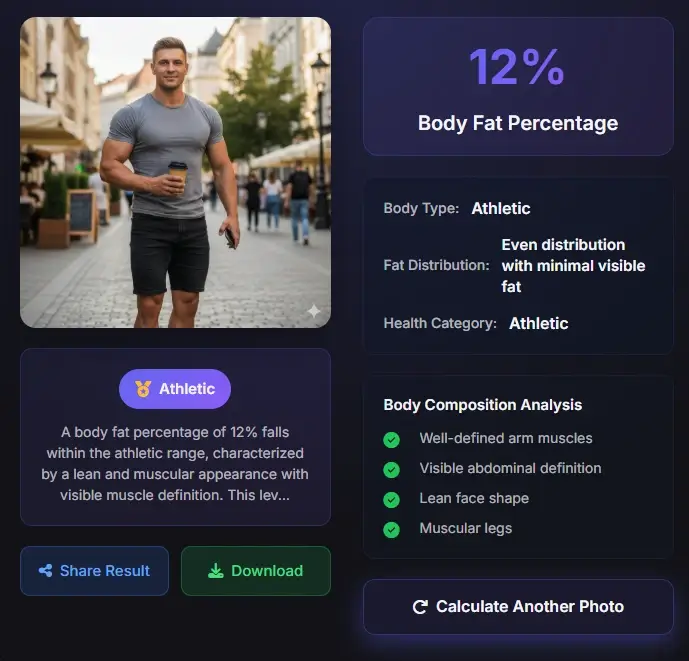
An AI body fat estimator can reduce some guesswork by applying the same analysis process each time. That is useful when you upload photos under similar conditions. It is less useful when one photo is a relaxed daylight shot and the next is a flexed gym mirror photo with strong shadows.
A simple workflow
- Take one front photo and, if possible, one side photo in the same lighting.
- Use the same fitted clothing and relaxed posture each time.
- Run the image through an AI estimate and record the range, not only the exact number.
- Repeat every 2-4 weeks instead of checking daily.
- Compare the trend with scale weight, waist size, strength, and how clothes fit.
This approach keeps the tool in the right role: helpful visual feedback. Try the free AI body fat calculator when you want a quick photo-based estimate, then use this guide to judge whether the photo itself is good enough.
FAQ About Body Fat Estimate Pictures
Can a picture tell my exact body fat percentage?
No. A picture can support a visual estimate, but it cannot directly measure fat mass. Treat the result as a range and trend signal.
What is the best body fat photo for AI analysis?
The best body fat photo is clear, well lit, front-facing, and taken with fitted clothing. Keep the camera level and avoid extreme flexing or shadows.
Is visual body fat percentage more useful than BMI?
It depends on the question. BMI is useful for quick adult weight-status screening, while visual body fat percentage gives more context about body composition. Neither is a full medical diagnosis.
How often should I take body fat estimate pictures?
Every 2-4 weeks is usually enough for progress tracking. Daily photos often create noise because hydration, food volume, lighting, and posture can change the visual result.
Can ChatGPT estimate body fat percentage from a photo?
Some AI tools can discuss visible body composition signals from images, but accuracy depends on image quality and the model. A dedicated body fat picture analyzer is usually easier because it is designed around that specific workflow.
How should I take pictures to estimate body fat?
Use relaxed front, side, and back photos with the camera near waist height, even lighting, fitted clothing, and the same distance each time. Avoid flexing, post-workout pumps, wide-angle distortion, and dramatic shadows.
Final takeaway
Body fat estimate pictures are useful when you standardize the photo and read the result as a range. For the most practical setup, combine consistent photos, waist or weight trends, and an AI estimate instead of relying on a single mirror picture.
Sources and Further Reading
- CDC BMI Frequently Asked Questions - BMI use and limitations.
- NICHD: How are obesity and overweight diagnosed? - body fat measurement context beyond BMI.
- Cleveland Clinic: DXA Scan - overview of DXA scanning.