체지방률 측정 방법: 집에서 하는 방법, 공식과 정확도
측정법을 선택하고 조건을 일정하게 유지하며 작은 변동을 해석하는 실용적인 가이드입니다.

이 가이드에서 다루는 내용
What body-fat percentage actually measures
Body-fat percentage is the estimated share of your total body weight that comes from fat tissue. The rest includes lean tissue, water, bone, organs, and other components. That makes it more specific than body weight alone, but it is still an estimate unless it comes from a controlled measurement method.
When people ask how to measure body fat percentage, they are often asking two different questions: how can I get a number today, and how can I tell whether my body composition is changing? A method can be useful for the second purpose even when it is not accurate enough to claim a precise absolute percentage.
BMI and waist-to-height ratio are useful screening indicators, but they do not directly measure body fat percentage. A muscular person, a person with a different fat distribution, or someone whose weight is changing quickly can receive useful context from these measures without treating them as a body-composition scan.
가장 유용한 원칙
Choose the method that fits your goal, repeat it under similar conditions, and look at a multi-week trend. Do not compare a smart-scale reading from one morning with a DEXA result from another month as if they were interchangeable.
Body-fat measurement methods compared
The table below is a decision aid, not a ranking of one universal best method. Convenience, repeatability, operator skill, hydration, and the question you are trying to answer all affect the choice.
| Method | At home? | Repeatability | Main limitation | Best for |
|---|---|---|---|---|
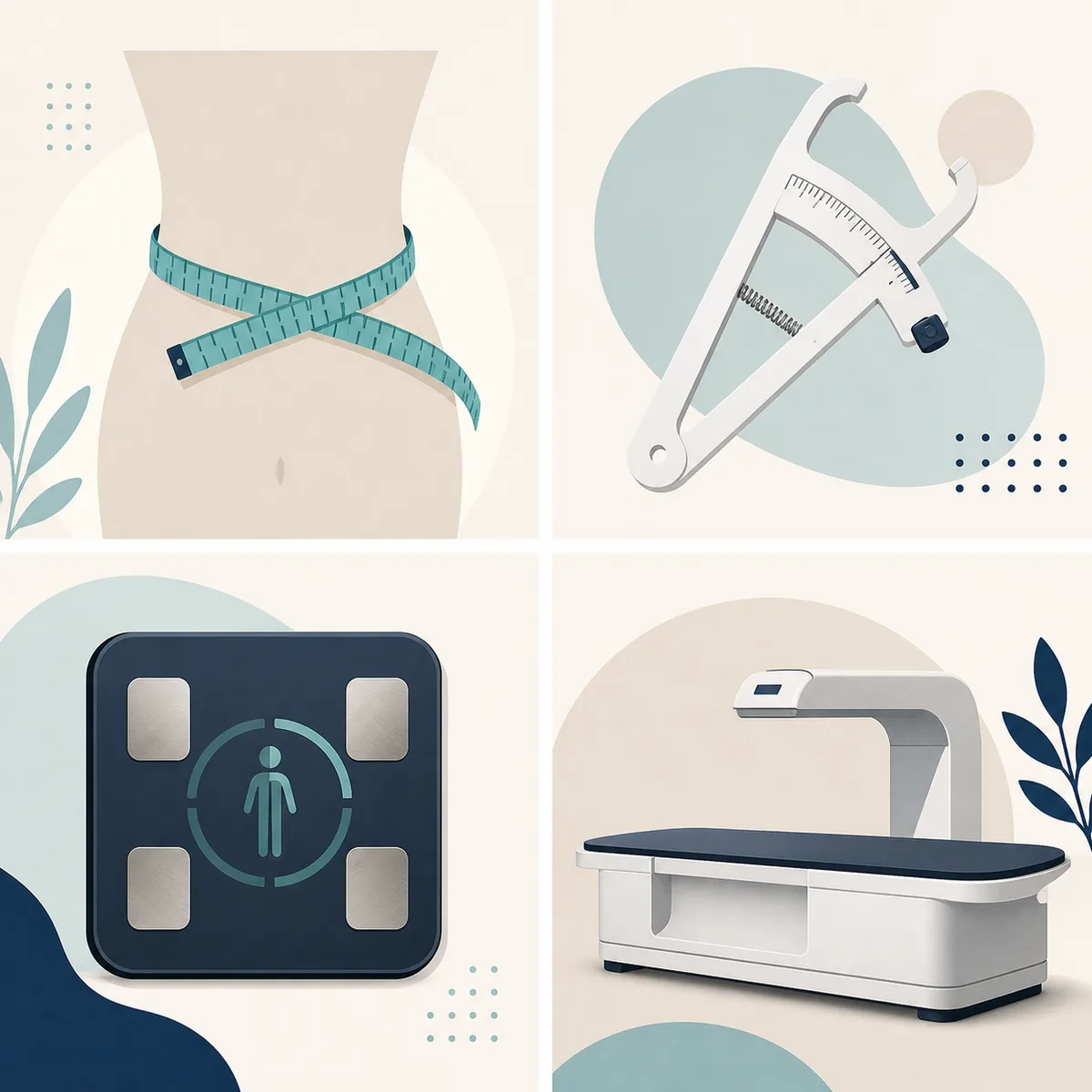
| Tape or circumference | Yes | Good with a fixed protocol | Does not directly measure fat tissue | Low-cost trend tracking |
| Skinfold calipers | Yes, with practice | Depends on skill and sites | Technique changes the estimate | Consistent experienced users |
| BIA scale or handheld device | Yes | Moderate if conditions match | Hydration and device algorithms matter | Convenient repeated readings |
| Photo or AI estimate | Yes | Depends on lighting and pose | Visual appearance is not a direct measurement | Range and progress context |
| DEXA or other lab method | No | Good in the same setting | Cost, access, and method assumptions | Detailed professional assessment |
If your goal is everyday tracking, a consistent tape, BIA, or photo routine may be more actionable than an occasional high-cost scan. If your goal is a clinical or performance decision, ask a qualified professional which method fits your situation.
How to measure body fat percentage with tape and circumference
A tape measure can support a body-fat estimate when it is paired with a validated formula, but the tape itself does not measure fat percentage. The result depends on the formula, the body sites used, the tape tension, posture, breathing, and the assumptions built into the equation.
For a simple home routine, measure at the same time of day, use the same tape, keep the tape level, and record the number before making a judgment. A circumference-based calculator can be useful for comparing direction over time, especially when the waist measurement and body weight are changing together.
측정 방법
- Use a consistent condition. Measure before training and preferably at a similar time, rather than comparing a relaxed morning measurement with a post-workout measurement.
- Place the tape carefully. Keep it horizontal, snug without compressing the skin, and use the same anatomical landmark every time.
- Take two readings. If the readings differ meaningfully, pause and repeat instead of averaging a poorly placed measurement.
- Record the context. Note body weight, date, time, and any unusual hydration, meal, or training condition.
If you want to track waist relative to height rather than estimate body fat directly, use the 허리-신장 비율 계산기.
Skinfold calipers: useful, but technique-sensitive
Skinfold testing estimates subcutaneous fat thickness at selected sites. A formula then converts those measurements into an estimated body-fat percentage. The method can be inexpensive, but it becomes less reliable when the tester cannot locate the same sites or apply the same pinch and caliper pressure each time.
Home users often get more value from learning one simple protocol and repeating it than from switching between several formulas. A trained tester may be more consistent, especially when the site locations are difficult to identify or the person being measured has a higher body-fat level.
측정 방법
- Learn the sites. Use the landmarks required by the chosen protocol and mark them consistently when learning.
- Pinch the same fold. Separate the skin and subcutaneous tissue from the underlying muscle without grabbing as much tissue as possible.
- Repeat the reading. Take multiple readings at each site and repeat the full set if one value looks obviously different.
- Keep the formula fixed. Do not compare outputs from different equations as if the formula change represented a real body change.
Calipers are best treated as a trend tool unless the tester, sites, equipment, and formula are all controlled.
BIA scales and handheld devices
Bioelectrical impedance analysis sends a very small electrical current through the body and uses resistance plus an algorithm to estimate body composition. The scale can be convenient, but the output is sensitive to hydration, recent food and drink, exercise, skin temperature, and the device's prediction model.
A BIA reading is easier to interpret when you use the same device, stand in the same way, measure at a similar time, and avoid treating day-to-day changes as meaningful. The number on the display may move because the measurement conditions changed, not because fat tissue changed overnight.
Do not assume that a more expensive consumer device is automatically a direct measurement or that two different brands are interchangeable. Use one device as a repeatability tool, and look for a trend across several readings rather than a perfect percentage.
BIA 해석 참고
If the reading changes sharply after dehydration, a salty meal, intense exercise, or a long fast, record the context before reacting. A stable protocol is often more important than the device's marketing accuracy claim.
Photos and AI body-fat estimates
A photo can help you compare visible body-composition ranges, but it cannot directly reveal an exact percentage. Lighting, posture, muscle mass, skin tone, camera distance, lens distortion, clothing, and fat distribution all affect appearance. An AI estimate adds a model's assumptions on top of those visual variables.
Photo-based estimates are most useful when you use them as a range and keep the image conditions consistent. They can help explain why a chart category looks different from your own body, but they should not replace a professional evaluation when a medical or performance decision depends on the result.
사진을 비교 가능하게 만드는 방법
- Use a front and side view with the same camera distance and relaxed posture.
- Keep lighting, clothing, background, and time of day as similar as practical.
- Avoid flexing, extreme angles, filters, or a single flattering frame.
- Compare a group of photos over several weeks, not one image with a random internet chart.
- Treat an AI output as an estimate range and compare it with waist, weight, or another method.
For a quick photo-based estimate, try the AI 체지방 계산기 또는 체지방률 사진 가이드.
DEXA, Bod Pod, and other professional methods
Professional body-composition methods can provide more detailed information than a home routine, especially when you need regional lean-mass and fat-mass estimates. They still have measurement error, protocol differences, cost, and interpretation limits, so a report should not be treated as an unquestionable personal truth.
DEXA uses low-dose X-rays to estimate bone mineral, lean tissue, and fat distribution. Air-displacement and underwater-weighing approaches use different physical assumptions. The important point is not that one method is universally perfect; it is that a controlled setting can reduce some of the day-to-day noise that affects home estimates.
- Consider the purpose. A professional scan may be reasonable for a detailed baseline, a sports program, or a clinical question, but it may be unnecessary for ordinary progress tracking.
- Use the same setting for follow-ups. If you repeat a scan, use the same provider and follow a similar preparation protocol so the change is easier to interpret.
- Read the report as an estimate. Ask what the method measures, what it assumes, and what uncertainty or regional variation should be expected.
If you have symptoms, a diagnosed condition, or a reason to make a health decision from body-composition data, discuss the result with a qualified clinician rather than relying on a consumer calculator.
How to track body-fat change without chasing noise
The practical question is often not “what is my exact body-fat percentage today?” but “is my body composition moving in the direction I want?” A repeatable routine gives you a better answer.
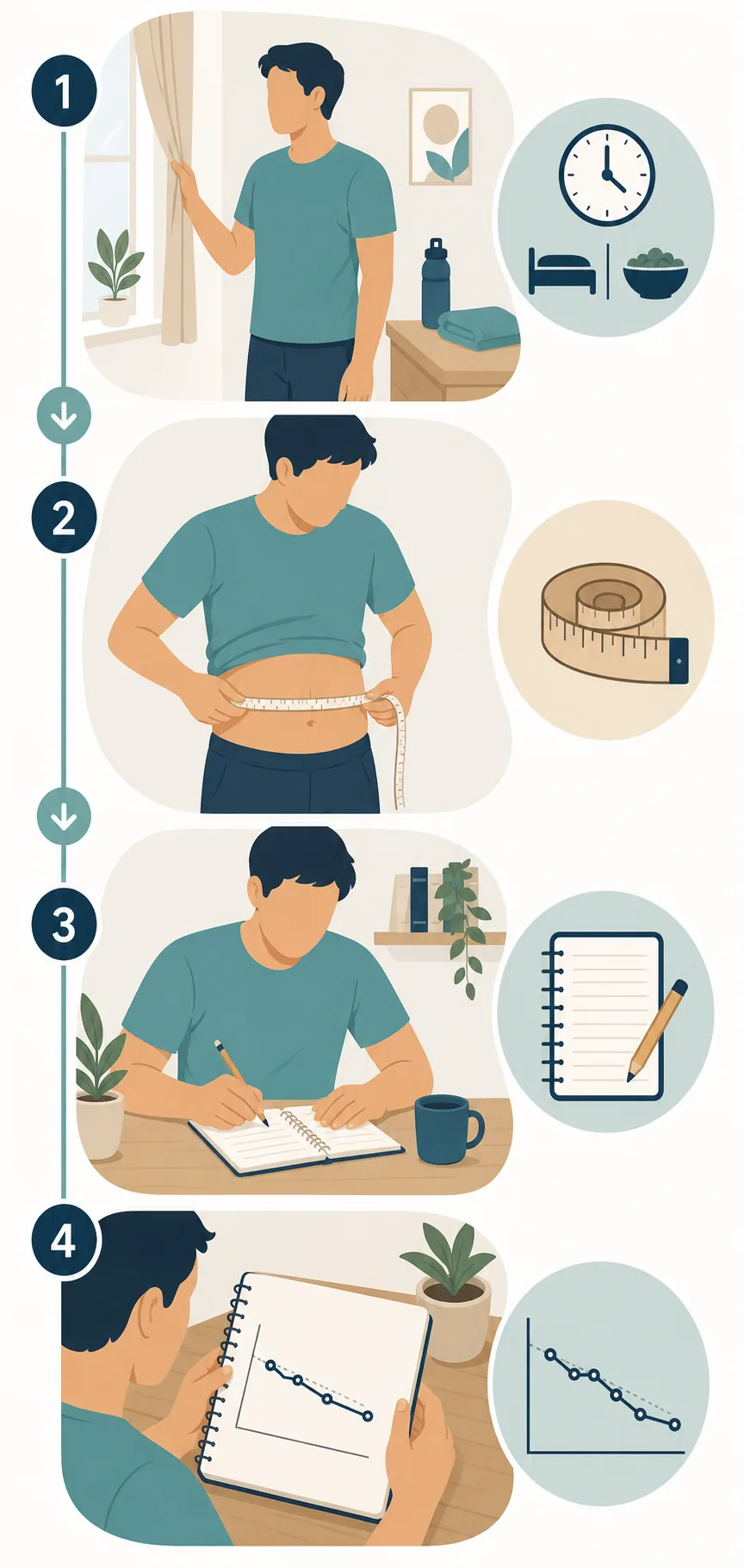
- Choose one primary method. Use tape, BIA, photos, or a professional scan as the main series instead of mixing unrelated outputs.
- Set a measurement schedule. A home method can be checked weekly or every two to four weeks; the right interval depends on the method and your goal.
- Control the conditions. Keep time, hydration, meals, training, clothing, camera, and posture as similar as practical.
- Track supporting signals. Record body weight, waist measurement, training performance, photos, and how you feel so one estimate does not control the whole interpretation.
- Review the trend. Look across several readings and ask whether the direction is consistent before changing a plan.
A good measurement routine should reduce anxiety, not create a daily scorekeeping habit. If a number conflicts with visible progress, strength, waist change, or other context, recheck the protocol before assuming your body suddenly changed.
Common body-fat measurement mistakes
- Comparing different methods. A BIA reading, photo estimate, circumference formula, and DEXA report are not the same scale.
- Measuring after a major condition change. Exercise, dehydration, a large meal, and unusual sodium intake can change some readings without changing fat tissue.
- Changing the protocol every week. New tape landmarks, a different device, or a new photo angle makes the trend harder to interpret.
- Treating BMI as body fat. BMI can add weight-status context, but it does not distinguish muscle, fat, and distribution.
- Using one percentage as a diagnosis. Estimates have uncertainty. Health decisions should include symptoms, history, and professional context when relevant.
FAQ: 체지방률 측정 방법
집에서 체지방률을 측정하는 가장 쉬운 방법은 무엇인가요?
A BIA scale or a consistent photo-and-tape routine is usually easiest. The best choice is the method you can repeat under similar conditions, not necessarily the device with the biggest accuracy claim.
줄자만으로 체지방률을 직접 측정할 수 있나요?
No. A tape measures circumference. A calculator may combine circumference with height, weight, sex, or other inputs to estimate body fat, but the output depends on the formula and measurement technique.
체지방 측정 체중계는 얼마나 정확한가요?
They can be useful for repeated trends, but hydration, food, exercise, temperature, foot contact, and the device algorithm can shift the estimate. Do not treat a single reading as a precise measurement.
사진이나 AI 체지방률 추정은 믿을 만한가요?
It is better viewed as a visual range than an exact percentage. Keep pose, lighting, distance, clothing, and camera settings similar, then compare results over time and with another signal such as waist measurement.
체지방률은 얼마나 자주 측정해야 하나요?
For a home method, weekly or every two to four weeks is usually more useful than checking several times a day. Use a longer interval when the method is noisy or when you want to judge a real trend.
미 해군식 방법과 허리-신장 비율의 차이는 무엇인가요?
A Navy-style method uses circumference measurements in a formula to estimate body fat. Waist-to-height ratio is a screening measure that relates waist size to height; it is not the same as a direct body-fat percentage measurement.
집에서 하는 방법 대신 DEXA를 사용해야 하는 경우는 언제인가요?
Consider a professional assessment when you need detailed regional body-composition information or have a health or performance reason to reduce measurement uncertainty. Ask the provider how the method should be prepared and interpreted.
마무리
To measure body fat percentage well, choose a method that fits your goal, keep the protocol stable, and interpret the result as an estimate. Home tools are useful for trends; professional methods can add detail; neither removes the need for context.
출처 및 추가 읽을거리
- CDC: About Adult BMI — Explains what BMI can and cannot tell you about body composition.
- British Heart Foundation: Best Way to Measure Body Fat — Overview of body-fat measurement options and practical limitations.
- Healthline: Ways to Measure Body Fat — Plain-language comparison of common home and professional methods.
- NIH/PMC: Body Composition Assessment Review — Research review discussing body-composition measurement methods and uncertainty.
- U.S. Army: Body Composition Program Update — Example of why military body-composition standards and formulas should be checked against current official guidance.